Eye Donation Month November 2026
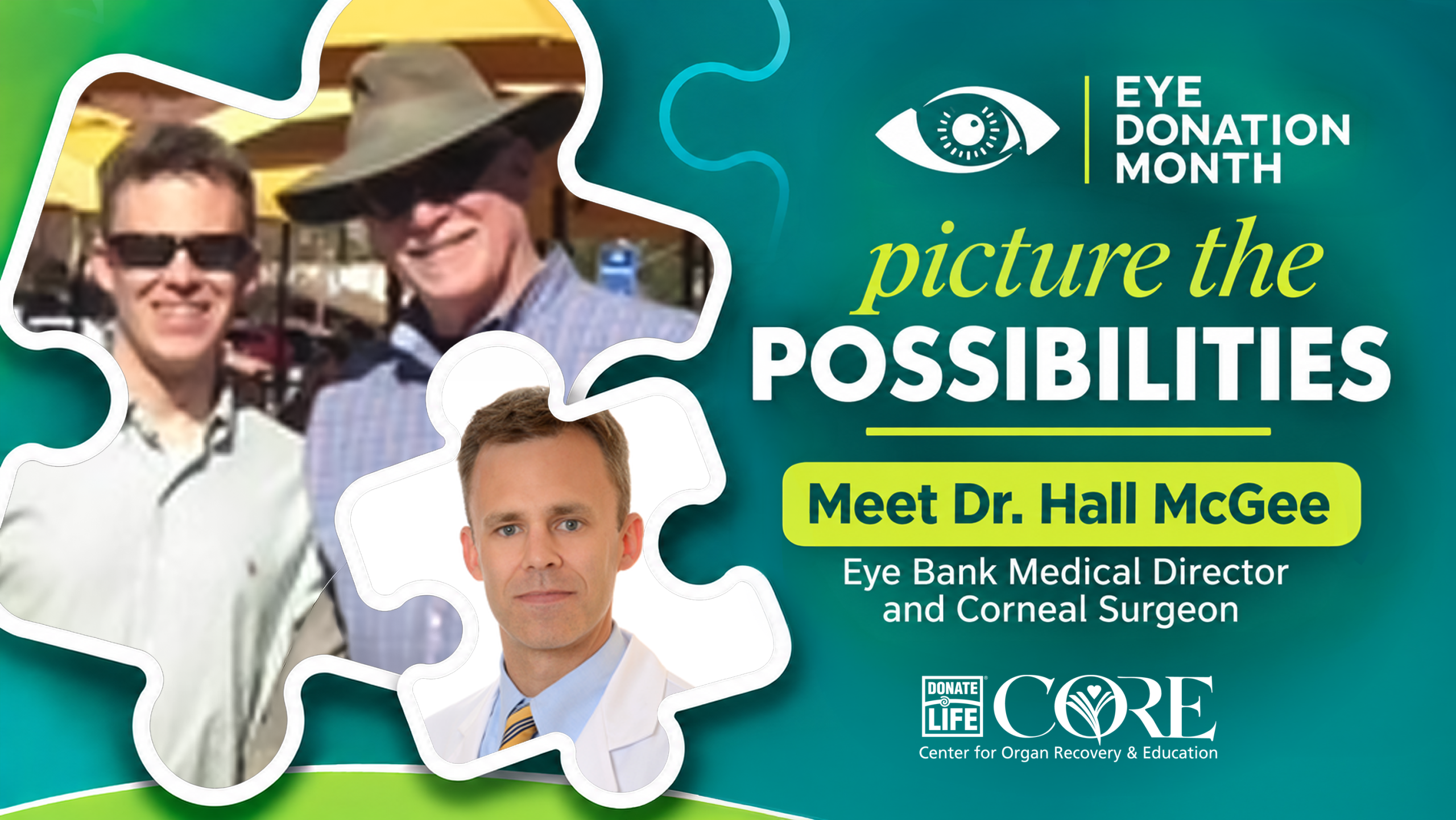
More Than the Gift of Sight: Dr. McGee on What It Means to Save and Heal Lives
For CORE’s Eye Bank medical director, a family experience helped inspire a career dedicated to improving the quality of people’s lives.
When Dr. Hall McGee was in medical school, his father-in-law, an architect, experienced serious complications following cataract surgery, including retinal detachments in both eyes.
His vision was ultimately preserved, but it was a difficult experience for someone whose livelihood depended on his eyesight. What stayed with McGee, though, wasn’t just the medical outcome. It was how his father-in-law felt about the physician who cared for him.
Despite everything he had been through, he loved his ophthalmologist.
“I figured, boy, if you can have that kind of a rough go of things and come out the other end loving your doctor, like there’s something to that,” McGee recalled.
That experience helped lead him to ophthalmology and, eventually, to a career as a cornea transplant surgeon.
Today, McGee is a cornea transplant surgeon with Everett & Hurite Ophthalmic Association and serves as medical director of the Center for Organ Recovery & Education (CORE) Eye Bank. In both roles, he works to help patients regain their vision, find relief from pain and enjoy a better quality of life.
As CORE recognizes National Eye Donation Month this November, McGee is the first in a series of local surgeons sharing their experiences with cornea transplantation and the people who make it possible.
A Different Way of Looking at the Gift of Sight
For McGee, the rewards of cornea transplantation aren’t always measured by how well someone can read an eye chart.
He’s cared for patients who were effectively legally blind before surgery and, in exceptional cases, regained nearly 20/20 vision within a week. Those outcomes are remarkable, he said, although most patients take longer to recover.
Other patients may never regain significant vision, but a transplant can relieve the debilitating pain caused by certain corneal conditions.
“For quality of life, it makes a huge difference,” McGee said.
That ability to improve someone’s everyday life is what continues to make ophthalmology so meaningful to him. A cornea transplant may allow someone to return to work, recognize a loved one’s face or simply live without constant discomfort.
And thanks to advances in medicine, the possibilities continue to grow.
When McGee began his training, surgeons typically replaced the full thickness of a damaged cornea. Today, they can often transplant only the affected layers, preserving healthy tissue and improving treatment options.
Those advances have also changed who can donate.
In fact, McGee said some newer transplant techniques work better with corneas from older donors. Surgeons may specifically request tissue from people well into their golden years.
“People who are, you know, 70 years or sometimes even older are often fantastic donors,” he said.
It’s something he hopes more people understand. Age, poor eyesight and many medical conditions don’t automatically rule someone out of cornea donation. Each potential donor is evaluated to determine whether their tissue can be used.
McGee is also excited about research exploring whether healthy corneal cells from a single donor could eventually be grown in a laboratory and used to help multiple patients.
The technology continues to evolve, but one thing hasn’t changed: Every transplant begins with someone’s decision to give.
The People Who Make It Possible
When patients thank McGee for restoring their sight, he has a favorite response.
“Our donors are the heroes, and I’m just the install guy.”
It’s a modest description of highly specialized surgery, but McGee means it. Without donated corneas, even the most skilled surgeon cannot perform these procedures.
He has also met donor families and seen what donation can mean to people grieving the loss of someone they love. Even when corneas are the only tissues someone can donate, the opportunity to help another person can bring comfort during an incredibly difficult time.
That appreciation is shared by the team at CORE’s Eye Bank, which has served the region since 1997.
Located at CORE’s Pittsburgh headquarters, the eye bank recovers, evaluates, prepares and distributes donated corneal tissue for transplantation, research and education. Its specialized capabilities support the advanced surgical techniques McGee and other surgeons use to restore sight.
The eye bank’s impact continues to grow.
In 2025, 985 cornea donors across CORE’s service area helped restore sight to 990 people, a 9% increase in donors over the previous year. CORE’s eye donation program also recovered 1,089 corneas.
While CORE is committed to meeting the needs of local surgeons and patients, donated tissue can also help people elsewhere in the United States and around the world.
For McGee, those numbers represent far more than procedures. They represent families who found meaning in donation and people whose lives are better because of their generosity.
What It Really Means to Save a Life
Toward the end of our conversation, McGee recalled something he learned during his medical education that has stayed with him throughout his career.
“No one’s life has ever been saved,” he remembered hearing. “We’re all going to die eventually, and so all we can do is to try to save life years.”
It may sound like an unusual observation from a physician, but McGee sees an important truth in it: Medicine isn’t only about helping people live longer. It’s also about helping them live better.
For a cornea transplant recipient, that might mean regaining independence, finding relief from pain or being able to see the people and places they love.
“We’re talking about improving the quality of the years that they’ve got,” he said. “I love the mission of CORE to heal and save lives through donation. There could be no better encapsulation of what we’re talking about here than that.”
Years ago, watching his father-in-law navigate a frightening experience with his vision helped McGee recognize the difference a physician could make in someone’s life.
Today, he helps make that difference for others. But he is quick to remind his patients that none of it would be possible without the donors and families who make the gift of sight possible.
During Eye Donation Month, their generosity reminds us that saving and healing lives can take many forms. Sometimes, it means giving someone more years. And sometimes, it means helping them see and experience more of the years they have.
Picture the possibilities.
This National Eye Donation Month, join CORE in honoring the donors and families who make the gift of sight possible. Register as an organ, tissue and cornea donor at CORE.org/register and share your decision with your family.
Photo caption: Dr. Hall McGee (left) with his father-in-law, whose experience with serious vision complications helped inspire McGee’s career in ophthalmology.
or CORE’s Eye Bank medical director, a family experience helped inspire a career dedicated to improving the quality of people’s lives.
When Dr. Hall McGee was in medical school, his father-in-law, an architect, experienced serious complications following cataract surgery, including retinal detachments in both eyes.
His vision was ultimately preserved, but it was a difficult experience for someone whose livelihood depended on his eyesight. What stayed with McGee, though, wasn’t just the medical outcome. It was how his father-in-law felt about the physician who cared for him.
Despite everything he had been through, he loved his ophthalmologist.
“I figured, boy, if you can have that kind of a rough go of things and come out the other end loving your doctor, like there’s something to that,” McGee recalled.
That experience helped lead him to ophthalmology and, eventually, to a career as a cornea transplant surgeon.
Today, McGee is a cornea transplant surgeon with Everett & Hurite Ophthalmic Association and serves as medical director of the Center for Organ Recovery & Education (CORE) Eye Bank. In both roles, he works to help patients regain their vision, find relief from pain and enjoy a better quality of life.
As CORE recognizes National Eye Donation Month this November, McGee is the first in a series of local surgeons sharing their experiences with cornea transplantation and the people who make it possible.
A Different Way of Looking at the Gift of Sight
For McGee, the rewards of cornea transplantation aren’t always measured by how well someone can read an eye chart.
He’s cared for patients who were effectively legally blind before surgery and, in exceptional cases, regained nearly 20/20 vision within a week. Those outcomes are remarkable, he said, although most patients take longer to recover.
Other patients may never regain significant vision, but a transplant can relieve the debilitating pain caused by certain corneal conditions.
“For quality of life, it makes a huge difference,” McGee said.
That ability to improve someone’s everyday life is what continues to make ophthalmology so meaningful to him. A cornea transplant may allow someone to return to work, recognize a loved one’s face or simply live without constant discomfort.
And thanks to advances in medicine, the possibilities continue to grow.
When McGee began his training, surgeons typically replaced the full thickness of a damaged cornea. Today, they can often transplant only the affected layers, preserving healthy tissue and improving treatment options.
Those advances have also changed who can donate.
In fact, McGee said some newer transplant techniques work better with corneas from older donors. Surgeons may specifically request tissue from people well into their golden years.
“People who are, you know, 70 years or sometimes even older are often fantastic donors,” he said.
It’s something he hopes more people understand. Age, poor eyesight and many medical conditions don’t automatically rule someone out of cornea donation. Each potential donor is evaluated to determine whether their tissue can be used.
McGee is also excited about research exploring whether healthy corneal cells from a single donor could eventually be grown in a laboratory and used to help multiple patients.
The technology continues to evolve, but one thing hasn’t changed: Every transplant begins with someone’s decision to give.
The People Who Make It Possible
When patients thank McGee for restoring their sight, he has a favorite response.
“Our donors are the heroes, and I’m just the install guy.”
It’s a modest description of highly specialized surgery, but McGee means it. Without donated corneas, even the most skilled surgeon cannot perform these procedures.
He has also met donor families and seen what donation can mean to people grieving the loss of someone they love. Even when corneas are the only tissues someone can donate, the opportunity to help another person can bring comfort during an incredibly difficult time.
That appreciation is shared by the team at CORE’s Eye Bank, which has served the region since 1997.
Located at CORE’s Pittsburgh headquarters, the eye bank recovers, evaluates, prepares and distributes donated corneal tissue for transplantation, research and education. Its specialized capabilities support the advanced surgical techniques McGee and other surgeons use to restore sight.
The eye bank’s impact continues to grow.
In 2025, 985 cornea donors across CORE’s service area helped restore sight to 990 people, a 9% increase in donors over the previous year. CORE’s eye donation program also recovered 1,089 corneas.
While CORE is committed to meeting the needs of local surgeons and patients, donated tissue can also help people elsewhere in the United States and around the world.
For McGee, those numbers represent far more than procedures. They represent families who found meaning in donation and people whose lives are better because of their generosity.
What It Really Means to Save a Life
Toward the end of our conversation, McGee recalled something he learned during his medical education that has stayed with him throughout his career.
“No one’s life has ever been saved,” he remembered hearing. “We’re all going to die eventually, and so all we can do is to try to save life years.”
It may sound like an unusual observation from a physician, but McGee sees an important truth in it: Medicine isn’t only about helping people live longer. It’s also about helping them live better.
For a cornea transplant recipient, that might mean regaining independence, finding relief from pain or being able to see the people and places they love.
“We’re talking about improving the quality of the years that they’ve got,” he said. “I love the mission of CORE to heal and save lives through donation. There could be no better encapsulation of what we’re talking about here than that.”
Years ago, watching his father-in-law navigate a frightening experience with his vision helped McGee recognize the difference a physician could make in someone’s life.
Today, he helps make that difference for others. But he is quick to remind his patients that none of it would be possible without the donors and families who make the gift of sight possible.
During Eye Donation Month, their generosity reminds us that saving and healing lives can take many forms. Sometimes, it means giving someone more years. And sometimes, it means helping them see and experience more of the years they have.
Picture the possibilities.
This National Eye Donation Month, join CORE in honoring the donors and families who make the gift of sight possible. Register as an organ, tissue and cornea donor at CORE.org/register and share your decision with your family.
Photo caption: Dr. Hall McGee (left) with his father-in-law, whose experience with serious vision complications helped inspire McGee’s career in ophthalmology.
