Eye Donation Month November 2026 Story #3
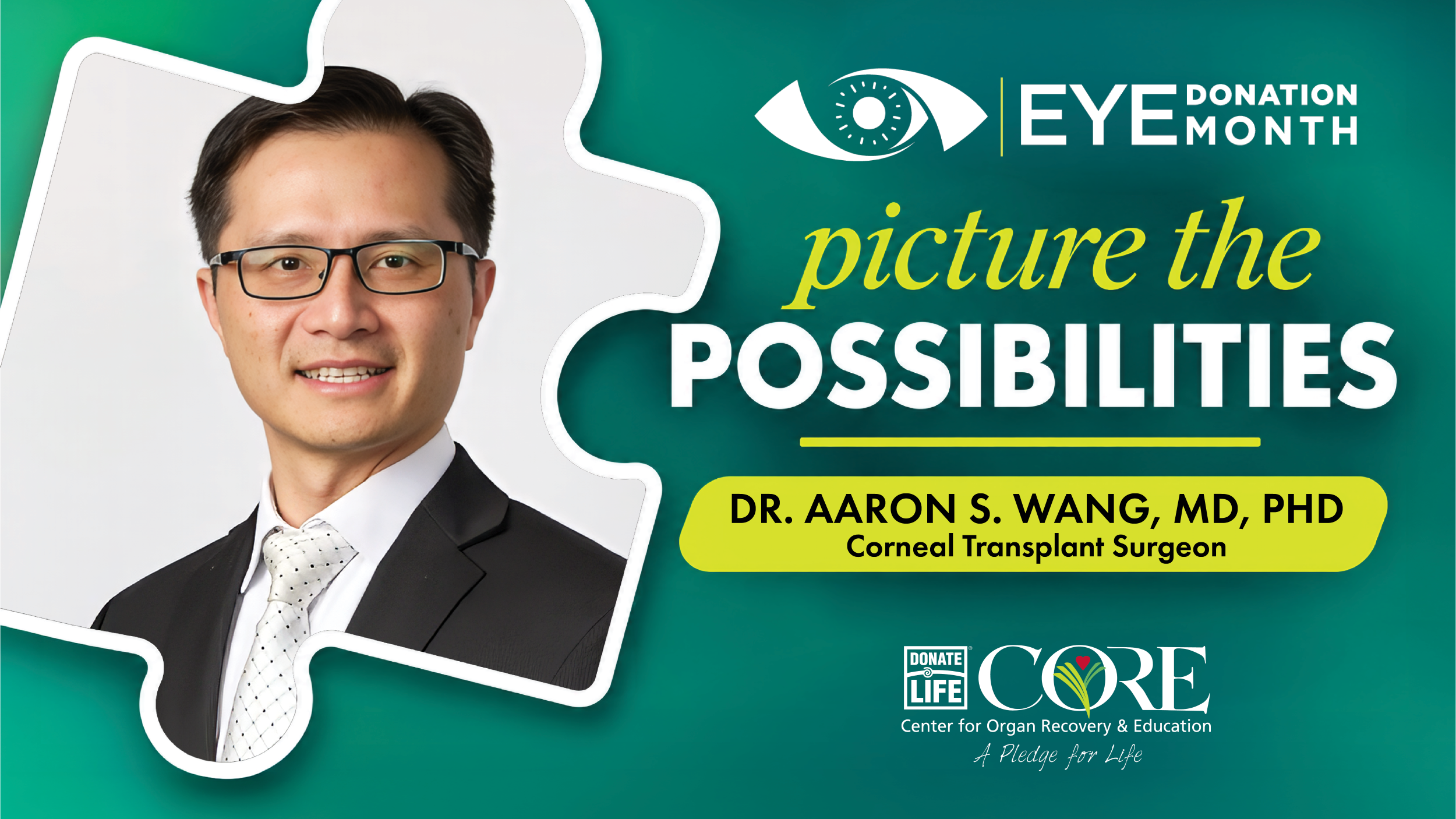
More Than the Gift of Sight: Dr. Wang on the Impact of Cornea Donation
“Giving the precious gift of sight is virtually equivalent to giving the gift of life.”
For Dr. Wang, the importance of sight is personal. Two life-changing experiences with eye surgeons, one involving his father and another involving his own vision, helped shape his decision to pursue ophthalmology. Today, he helps patients regain their sight through corneal transplantation, giving them the opportunity to experience the world in a new way.
A Personal Connection to Eye Care
Dr. Wang’s path to ophthalmology began with two experiences that showed him just how much vision can impact a person’s life. When his father was 40 years old, a cataract surgeon helped preserve his sight after identifying early cataracts. Later, while Dr. Wang was in college, a retinal surgeon helped save his own vision.
Both experiences left a lasting impression.
“Both of these events were life changing. I would otherwise not be able to become a surgeon,” Dr. Wang shared.
The idea of working on a small part of the body and making a significant difference in someone’s life ultimately led him to pursue ophthalmology in medical school.
During his training, Dr. Wang became especially interested in corneal transplantation. He was fascinated by the precision required to perform full-thickness corneal transplants, which involve sutures finer than human hair. He was equally impressed by the skill and ingenuity behind partial-thickness transplants.
A New Window to Life
The cornea is the clear front surface of the eye that helps focus light and allows us to see. When it becomes cloudy or damaged due to trauma, disease or degeneration, it can significantly affect a person’s vision.
Dr. Wang often compares the cornea to a car’s windshield.
“It’s basically like getting a new window to life,” he explained. “The cornea is like the windshield you look through in a car. If the windshield becomes scratched, dinged or cracked, one can get a windshield replacement. Similarly, if the cornea becomes foggy or cloudy, we can replace it through a full-thickness or partial-thickness transplant.”
Through corneal transplantation, surgeons can restore clarity and help patients return to activities that may have once seemed out of reach.
The Difference a Transplant Can Make
One patient remains memorable to Dr. Wang.
During his ophthalmology training, before deciding to become a cornea surgeon, he helped care for a patient who had lived with a significant corneal scar for decades following an injury as a teenager. The patient had been hesitant to undergo surgery and waited nearly 30 years before deciding to move forward.
Because the injury had caused significant damage, the procedure was especially complex and required considerable time and care in the operating room.
Throughout the lengthy surgery, Dr. Wang wondered whether the time and effort would ultimately make a meaningful difference for the patient.
The answer came soon after the procedure.
The patient was incredibly grateful, not only for the improvement in vision in the operated eye, but also for the return of depth perception. With that improvement, he could enjoy 3D movies and drive more easily and safely.
It was a powerful reminder that restoring sight can mean much more than seeing clearly. It can help people regain experiences, independence and confidence in everyday life.
The Gift of Cornea Donation
Corneal transplantation has several important differences from other types of organ transplantation. According to Dr. Wang, corneal transplants have a high success rate, do not typically require donor-recipient matching and do not involve the same type of waiting list as many other organ transplants.
Patients can generally schedule surgery at a time that works for them, with healthy donated tissue made available through the eye banking system.
That process is possible because of the generosity of donors and their families, along with the work of eye banks like CORE.
The Gift That Keeps Giving
For Dr. Wang, cornea donation represents an extraordinary opportunity to make a lasting difference in someone’s life.
“Giving the precious gift of sight is virtually equivalent to giving the gift of life,” he shared.
A single donated eye can also provide multiple layers of tissue, potentially benefiting more than one patient.
“We surgeons and patients greatly thank donors and their families for this tremendous selfless gift during an immensely difficult time.”
This National Eye Donation Month, CORE recognizes the donors and families whose generosity makes the gift of sight possible. Their decision creates opportunities for others to see the world more clearly and experience life in ways they may not have thought possible.
Picture the possibilities.
Learn more about eye donation and register your decision to be a donor at CORE.org/register. Be sure to share your decision with your family.